Conference Season!

It’s almost June, and for me that means conference! And this year it really is a “season” as I have two conferences coming up – and I seriously need to get my behind in gear and prepare for them both.

Jamboree

Jamboree!

The Southern California Genealogical Society is celebrating its 50th birthday this year at Jamboree 2019, May 31 – June 2 at the Burbank Marriott. This will be my fourth year attending Jamboree and in those four years I’ve gone from nervously slipping in, feeling like a know-nothing, to . . . well, blogging about it! I usually go into Jamboree with some knotty problem in mind and choose sessions that I hope will help me progress down the road to a solution. This year my mission is less genealogy-focused and more practical.
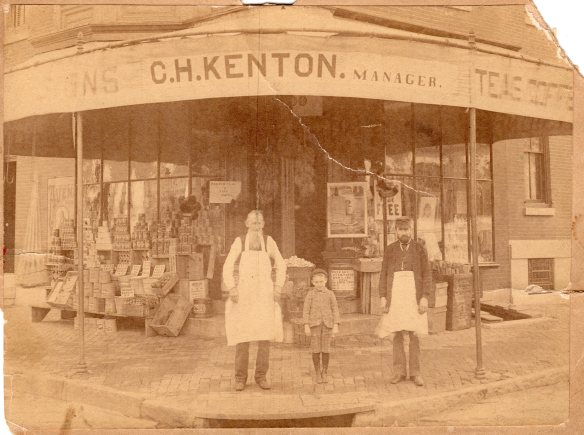
KentonFamilyStore004

William Kenton, George William Kenton, Charles Henry Kenton

This is one of our family’s most treasured photographs. The little boy is my great-grandfather, George William Kenton. He’s flanked by his father and his grandfather. Charles Kenton, my second great-grandfather, managed the general store in the photo. It’s on a street corner in Philadelphia, but we’ve never found out where or whose store it was. Someday I imagine I’ll have to page through the appropriate Philadelphia city directory to see if I can find it. The photo above is a scan of a color Xerox (remember those?) but this spring, during a massive organization and clean-out, I finally found the original tucked in a file folder in my mother’s house. I may have screeched when I opened that folder.

Jamboree has an amazing exhibit hall and there are usually several vendors who perform advanced photo restoration. I’ve always wanted to be able to bring this photo to the conference and see what they can do with it. At the very least I’d like to get rid of the tear and fold marks, which are part of the original photo, not the Xerox. So watch this space! Maybe we’ll get a great “after” photo!

avgs_banner

Another Jamboree highlight for me is the booth of the Antelope Valley Genealogical Society. That may seem strange, since I don’t do any California research, nor do I live in the Antelope Valley. But the folks from Antelope Valley always bring interesting materials from their collections to share at their table. One year it was big books of maps from Pennsylvania including detailed plans of the village of Maytown, with names of households (my ancestors included) indicated on each home. I always enjoy browsing their booth.

Of course, Jamboree is really about the lectures. Without a specific research goal this year, I’m planning to enjoy all the interesting sessions that I’ve had to bypass in the past. I love history, and I’m going to immerse myself in stories and case studies that might not pertain to my genealogy, but still fascinate me. And honestly, it’s kind of good that this year’s Jamboree will be more relaxed for me, because two weeks later I head up to Sacramento for June’s second genealogy conference.

iggp

The International German Genealogy Partnership is having their 2019 International German Genealogy Conference in Sacramento, California this year, from June 15-17 at the Hyatt Regency. The Partnership is an organization of member groups (Partners) from all over the world dedicated to German genealogical research. Since half of my ancestors come from Germany, and I have yet to really delve into German research, I’m super excited that I’ll be able to attend.

In Sacramento I’ll definitely have research goals and I’m sure I’ll come home with my head full of information and ideas. There’s a LOT going on that weekend and the schedule is massive. I plan to arrive very early on Saturday and hopefully have a couple of hours to get the lay of the land and make some plans. I definitely want to become more familiar with German geography and migration patterns, and some lessons in reading and translating records would be great as well. With so many sessions to choose from, the only problem will be when two lectures I’m interested in are scheduled at the same time. (But that’s what the syllabus is for, right?)

So I’ll be kicking off this summer with some serious genealogical immersion, and will come home ready to take advantage of those longer days to push my family tree deeper into the past. Let conference season begin!

babyheart


Doing the Happy Dance

Brick Wall

We all have them. That one family. The one with too many children, spread between different, unspecified mothers. The one that lived in a time and place with few records and fewer newspapers, none of which seem to be available online. The one that had a terribly common surname, common given names, making even what records can be found questionable. Is it your relative, or one of the many that must have shared his name?

For me, this was the King family.

King Pedigree

John King was my fourth great-grandfather. Before November 28, here’s what I knew about him: He was born in Ireland about 1809. At some point he immigrated to the United States and settled in Delaware. He was a farmer. He had a total of fourteen or fifteen children between two or possibly three different wives. Eventually, as all my ancestors did, he came to Philadelphia where he died and was buried at Mount Moriah Cemetery.

King_John

Tombstone of John and Ann Warnock King, Mount Moriah Cemetery, Philadelphia

I knew the names and ages of John’s children thanks to census records. I had a few baptism records from Old Swedes Church in Wilmington. I had information on some of the children’s later lives, others were complete blanks. I wasn’t even sure which children belonged to which wife, beyond the few for whom I’d found death certificates. Some of the older children’s death certificates indicated their mother was Mary Aiken, others Margaret Aiken. Were these two different women or Mary Margaret Aiken?

In short, I had a lot of blank fields and brick walls. And after researching this family for years, I had hit that point where you just know you’ve found all you can find and this is where you’ll be stuck forever, unless some fourth cousin magically turns up in your inbox with a pedigree chart compiled by an ancestor eighty or so years ago based on information provided by an eyewitness source, filling in all the blanks and offering details you never imagined being able to uncover.

Enter my new favorite fourth cousin, David Shand.

David messaged me on November 28 about our shared King ancestry and, based on things he said in his messages, I had that moment – you know it – where it slowly dawned on me that he knew things I didn’t. Where did this information come from? Was he making educated guesses based on the same records I had found or . . . did he have a source?! I asked, and he sent me this:

Shand2

King Family Tree – created by John King Wright, photo copyright David Shand

Any readers who pursue genealogy will know the emotions I had when I opened this image. First, it’s a tree compiled by someone who knew how to put together a pedigree chart. It’s beautiful. I got just a tad effusive on poor David, because what a treasure! This lovely tree was created by David’s great-grandfather, John King Wright, who was a grandson of John King and his second wife, Mary Aiken/Aikin. (The family seems to have vacillated on the spelling.) I noticed a few things right off the bat.

Shand3

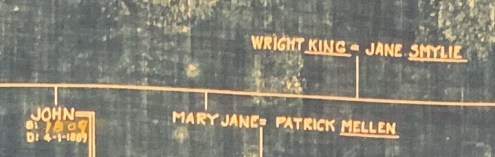
Parents of John King, photo copyright David Shand

It was a big deal to have the names and dates of marriage and death of John’s three wives, but even more exciting to me are his parents, Wright King and Jane Smylie. I had never heard these names, but my mom had a great Aunt Annie – sister of my great grandfather George Kenton, Sr. – whose full name was Annie Smiley Kenton. I never could understand why they’d given her such a strange middle name, considering that surname didn’t appear in my tree anywhere. Then there was this:

Shand4

Photo copyright David Shand

It falls off the end of the image a bit, but at the bottom of the chart John King Wright specifically names Ann Warnock as an informant. My own fourth great grandmother, the third wife of John King.

And of course, I can’t help including this little bit of sentimental value:

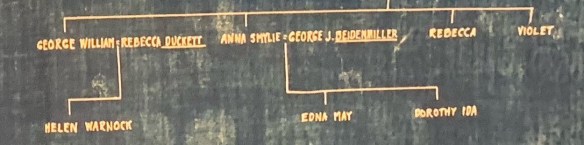
Shand5

Kenton Family in John King Wright’s tree, photo copyright David Shand

Down at the bottom, my own great grandfather, George Kenton, his wife, his sisters, and his oldest daughter, my Great Aunt Helen, for whom I am named.

And on the genealogical front, as I pored over the document and compared it to my tree, in almost every case where I already had information, John King Wright’s names and dates, based on his family knowledge, agreed perfectly with mine, based on documentary research. There are a few errors. Most notably, my Aunt Helen wasn’t Helen Warnock Kenton, she was Helen Bertha Kenton, and yes, they gave me the Bertha too. I would have preferred Warnock!

Honestly, this is the kind of thing you hear about happening to other people, but never expect to happen to you. I’ve said it before, I’m not related to anyone. Of my 436 “fourth cousin or closer” DNA matches on Ancestry, 415 are in that fourth cousin range. I simply never expect anyone to provide me with any juicy genealogical info.

I’m now hard at work incorporating all the new information this tree provides into my own trees. I’m attaching the children to the proper mothers, filling in spouses and descendants, forging through new Ancestry hints, and all around reveling in having not only all of this amazing information, but a new clue to try to take this family back in Ireland someday.

Happy, happy, happy.

babyheart

I Thought I’d Seen Everything…

Okay, first, my new laptop had to go in for repair so I’m trying to blog from my phone. I have no idea how this is going to turn out. But I just discovered something that I wanted to share and I don’t want to wait for HP to do its thing. Hopefully this will go as well as the WordPress app assures me it will.

Today I want to talk about census records. The backbone of genealogical research. When I first started working on my family tree, censuses were pretty much the only widely available online records. Like most researchers, I spent years in those records, using their various details to fill in the blanks of my ancestors’ lives. And after all that time, I thought I’d seen every little weirdness the census records had to offer.

I was wrong.

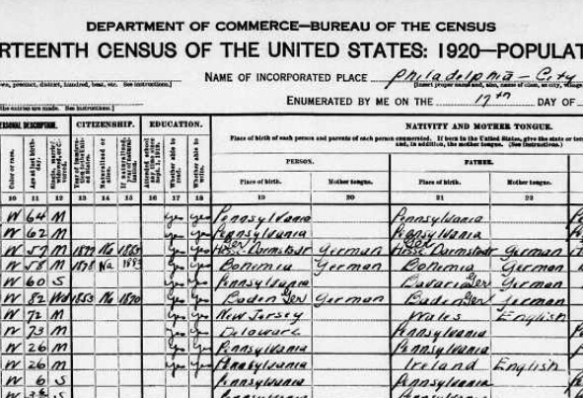
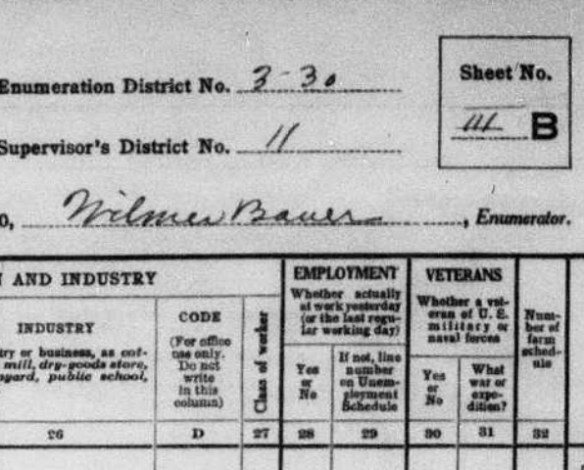
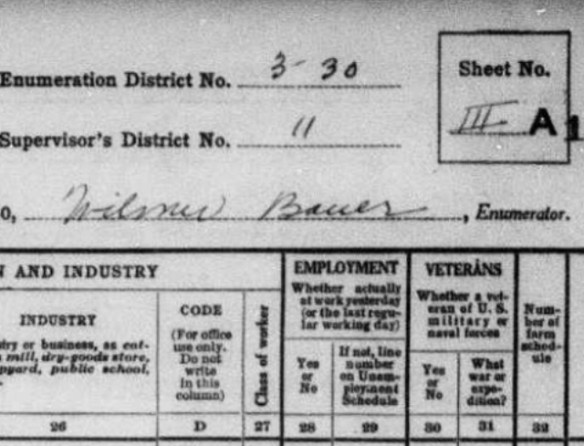
Recently, when I was recording a relative in the 1930 census in Delran, New Jersey, I came across this:

I was bopping along, writing my citation, inputting the page number, and . . . what?! For a while I just stared at it, wondering what number it could be. My brain was blank. To help me I moved back to the previous page:

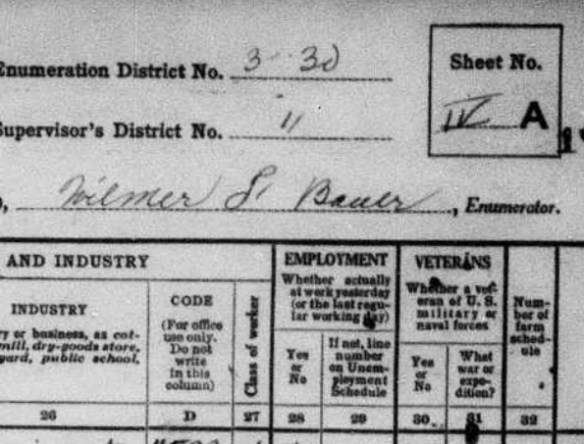
No, I still didn’t get it. So I checked the following page instead:

Wait . . . really? Were these . . .

Yes, they were.

Now for those readers unfamiliar with how the census worked in our past, townships were divided into enumeration districts and there was an enumerator, in this case Wilmer Bauer, assigned to collect and report the population details for each district. They canvased the neighborhoods and filled in these huge sheets with information for each and every person in their district. And they numbered their pages.

But here’s the thing. There are close to 2,000 people in my family tree. Almost all of those people appeared in at least one census, and the majority appeared in several. Which means I have searched, downloaded and cited thousands of census pages from across the country and the years. And Wilmer Bauer in Delran, New Jersey is the single, solitary enumerator I have ever seen number his pages with Roman numerals. So maybe you can understand why I stared at that III for so long, trying to figure out what kind of strange code it was!

In 1930 Delran (a little township in Burlington County) only had two census enumeration districts. Nettie Smith, who enumerated District 29, dutifully used Arabic numerals just like every other census enumerator I’ve come across in more than 20 years of using these records.

Why, Wilmer? That’s what I really want to know. What made this particular New Jersian (Jerseyan?) decide to take his 16 pages of Delran residents and stamp them with his Latin flair? Was he flouting the rules everyone else carefully followed?

As it turns out, the instructions to census enumerators for each decade of the census are available online at the Census Bureau web site. I recommend checking them out. They’re a surprisingly interesting read!

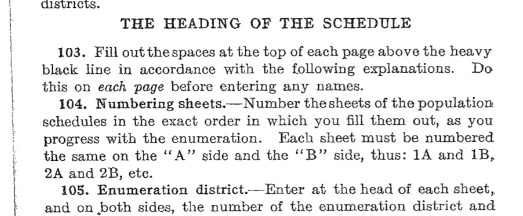
But for the purpose of answering my question, we’ll go straight to the 1930 section on numbering pages:

So . . . aside from matching your A side and B side, it doesn’t implicitly state that Arabic numerals must be used.

I like Wilmer Bauer. I like to imagine him making the choice to put his own stamp on his pages with those Roman numerals. To heck with the given example! To heck with how everyone else had ever done it in the history of the U.S. census! Wilmer was going to make his mark, darn it!

Maybe I’m being romantic. Maybe Wilmer always numbered everything in his life the Roman way and so didn’t think twice about doing it on his census pages. Either way, I suspect he was a interesting dude. And 88 years after he made that choice, he knocked me out of the rote of source citations and gave me something to marvel at. That’s pretty cool.

You do you, Wilmer Bauer.

Absolutely Ordinary

One thing I’ve noticed during my years pursing genealogy: when someone outside the genealogy world discovers you’re researching your family tree, you can bet the first thing they’ll ask is whether you’re related to anyone famous. I’m always taken aback by the question, even though I get it so often. The quest for famous ancestors is so far from why I do what I do.

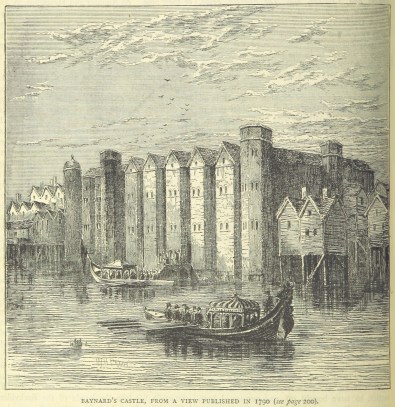
Now don’t get me wrong. It would be cool to discover I was descended from English royalty or Caribbean pirates. My mother has Baynards way back in her Maryland line, and there are rumors they might be descended from Ralph Baynard. You’ve probably never heard of him, but he built Baynard’s Castle, which stood near what is now Blackfriars in London. They tell you all about it on those Thames boat tours. He’s also the person the Bayswater area of London is named after. And, oh yeah, he crossed the channel with William the Conqueror and . . . conquered. Blasé as I’d like to be about famous connections, if I found real evidence that Ralph Baynard was my ancestor, you can bet they’d hear me squealing in Bayswater. But no, I’m not descended from anyone famous. That I can prove. Yet.

Baynard's Castle

Baynard’s Castle – potentially my ancestral seat (if it were still standing . . .)

Connections to Norman conquerors aside, you know what keeps me at this day after day, and leaves me bubbling over with stories that I had to start a blog just to tell? The ordinary, everyday stuff of the past, and the people who lived through that stuff. That’s what I can relate to and what brings the past alive for me. So when people ask me what exciting ancestors I’ve discovered, I always tell them about Mary Fisher.

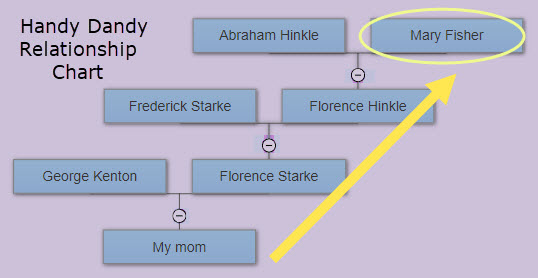
Mary Fisher Chart

Mary Fisher was my second great grandmother directly up my female line and on the surface, she was as ordinary as her name. I don’t have any photos of her, or newspaper clippings about interesting things she did. She wasn’t associated with any important events. She lived, she bore children, she brought her family to Philadelphia to fulfill the timeline that would lead to me, and she died. But as is so often the case with family research, dig a little deeper and there’s . . . more to the story. (See what I did there?)

Mary was born in 1856 in Berks County, Pennsylvania, to George Fisher and his wife Catherine. The family first appears on the census in 1860 living in South Manheim township in Schuylkill County. Even by the standards of the time, George was on the low end of the socio-economic scale. Coal hadn’t completely taken over the region yet; most of George and Catherine’s neighbors were farmers and craftstmen. We find boat builders and shoemakers, railroad workers and bricklayers. George was enumerated simply as a laborer. His personal estate – everything he owned in the world – was valued at $20. When many of their adult neighbors, male and female, could read and write, George and Catherine could not. In 1860 Mary was only four years old, the eldest of three daughters. In the next few years two more girls were added to the family, and two passed away.

And then, sometime between 1860 and 1870, George disappeared. He probably died, as Catherine eventually remarried, but I’ve never found any evidence of a death. He may have died in the Civil War, but again, there are no records I can substantiate as his. What I do know is that in 1870 Catherine was enumerated in the nearby town of Butler as the head of her household of three girls, Mary, age fourteen, Susanna, who was six, and little Minnie, just three years old. Catherine was now the breadwinner, working as a housekeeper in someone else’s house. And we can infer that the housekeeper at the Fisher house – the person doing all the cooking and cleaning and child care – was 14-year-old Mary.

Two years later, at the age of 16, Mary Fisher married Abraham Hinkle, a 22-year-old coal miner. It was almost certainly a shotgun wedding.

HinkleFisher

Marriage Records of Christ United Lutheran Church, Ashland, PA

You see it, right? To steal a phrase, it’s a tale as old as time. Teenage girl, stuck at home caring for her younger siblings, which was a lot more work then than it is now. Finds a nice young man and sees the chance to be out from under mom’s thumb. If she has to work it might as well be in her own home where she’s in charge. The Hinkles weren’t rich, but they were well ahead of the Fishers. Mary wouldn’t have been the first girl to take the “oops” route out of her parents’ house and into her own.

Of course, all this is speculation. I don’t have an exact birth date for Mary’s oldest daughter, but her age is within the range that would make a pre-wedding pregnancy feasible. And it seems unlikely that with a full-time job and an 8- and 5-year-old to care for, Catherine would have let Mary go for anything less than absolute necessity. She was, after all, only sixteen.

There’s obviously no way to know what went on in Mary’s head, but that’s part of what makes it all so interesting to me. I can imagine her situation so easily. I knew girls in high school who took the same route Mary may have. It’s so familiar, even though it’s deep in the past. Mary was ordinary. What happened to her was common. But the details of her situation tease at my brain. The fact that I’ll never know the truth doesn’t keep me from coming back to her, over and over again.

And there’s more!

You know that saying, out of the frying pan, into the fire?

By 1880, eight years into her marriage, Mary had a husband in the mines all day and four children at home – none of them yet attending school. She probably had had a fifth in that same time period who didn’t survive. She would go on to have six more. Eleven children in a twenty-year span. Twenty plus years of somebody always in diapers, always nursing. Twenty years of pregnancy after pregnancy. I honestly can’t imagine surviving it, although of course millions of women did. I can imagine that Mary’s three oldest – all girls – had their own moments of teenage frustration when Mary pressed them into cooking, cleaning, and child care duty. But none of them took Mary’s way out.

Despite a number of pregnancies that makes my eyes cross, Mary lived to the ripe old age of 79. She and Abraham eventually took that huge family to Philadelphia – I like to think to get the boys out of the mines. I also like to think that Mary got to enjoy a couple decades of peace and quiet after all those years of toil. She passed away in 1935 in a little house on Wendle Street, cared for by . . . her younger sister Susanna. Full circle.

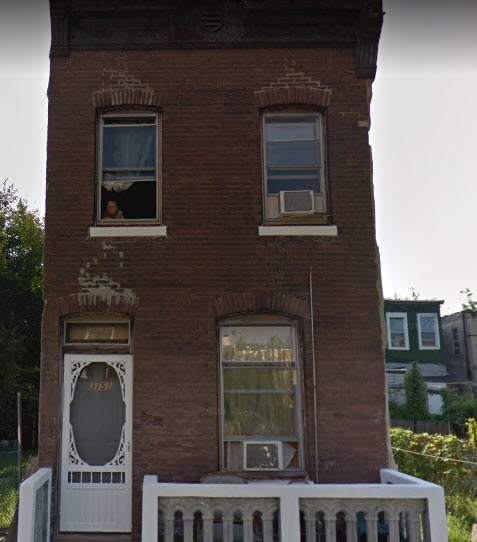
3151Wendle

The house on Wendle St. where Mary lived her final years.

Mary Fisher is honestly one of my favorite ancestors. I think about her often. I wonder if she regretted the decision I like to believe she made. In the thick of motherhood, did she long for the time when she only had two little sisters to care for? Or did she love her husband and thrive on having her own family, huge as it was? That’s just another thing I’ll never know. Mary’s youngest daughter Florence – my great-grandmother – died when I was four and I don’t remember my own grandmother ever talking about her. So in a lot of ways she’ll always be a mystery to me. But mysteries are why we do this, right?

Every year I go to our Southern California Genealogical Society Jamboree – a national-level genealogy conference. In the course of the four days I talk to a lot of people. We chat before sessions or over lunches. Everyone wants to share about their ancestors. But in all the years I’ve been going, I couldn’t tell you one time someone told me about being related to someone famous. No, I hear about the little, quirky, everyday events they’ve discovered researching their absolutely ordinary ancestors. I hear about their Mary Fishers. And then I tell them about mine.

But what about poor Catherine, left with her full-time job and her two small children? Never fear! After she lost Mary she quickly found herself a husband – Abraham Hinkle’s older brother Frank. Making her her own daughter’s sister-in-law and making my pedigree chart very unhappy. But that’s a slightly less ordinary story for another day.

babyheart


My Grandmother’s Stories, or, At Least It Wasn’t a Radioactive Spider

Drew Smith, co-host of the Genealogy Guys podcast that I talked about in my first post, always asks his interviewees to tell their Genealogical Origin Story. How does a mild-mannered average citizen become a minutia-obsessed, microfilm-reading, cemetery-scouring genealogical superhero? I like this idea. I’m stealing this idea.

You know how I decided to start blogging. But how did I get into genealogy in the first place? Here is my Origin Story.

Like most of us, I had several reasons for wanting to explore my family history. Both of my parents are only children, which leaves me with no aunts, uncles or first cousins and a strong desire for the kind of family connections I just wasn’t born to. Also, my mother is a Kenton, and I’d always wanted to know if we were related to bandleader Stan Kenton (we are) or mountain man Simon Kenton (that jury’s still out). But most of the blame for my first steps down the road of family history research rests squarely on the shoulders of one woman.

Houseal_Gladys

Meet Gladys Agnes Houseal, my paternal grandmother. Wife of Ed Moore of my last post. Impish little girl sitting on that stool in my banner collage. Keeper of family stories.

My grandmother was born a Houseal and if there’s one thing I’ve learned in the 20-plus years I’ve been pursuing genealogy, it’s that Houseals love family stories.  Over and over again, when I find and connect with distant Houseal cousins, I hear the same stories that my grandmother told me when I was growing up. Do I know that there was only ever one family of Houseals in America, so if you meet one, you’re definitely related? Yes, I’ve known that since I was five. Have I heard about cousin Lou Houseal who had his head cut off by a plane propeller under . . . suspicious . . . circumstances? Yes I have, and I so want to know the truth about that one!

Houseal_Louis_Edwin

Louis Houseal, whose death by propeller may or may not have been an accident…


My grandmother’s stories didn’t just lean to the Houseal side. I heard about Great Grandfather Galheber – he’s up there in the banner too, holding a baby –  who was born on the boat coming to America and who had red hair like me, and a bright red mustache. (“In his coffin!” she always said. “I can still see him lying there with all that red hair!”) Then there was Grandmother Reed, who had a farm in Delaware that everyone loved to visit. And we absolutely can’t forget Stacey Doran, our Revolutionary War patriot ancestor who crossed the Delaware with Washington and whose cuff buttons had been handed down all the way to my great uncle Ed. I wish I had a dollar for every time I was reminded that I was eligible to join the Daughters of the American Revolution.

Reid_John_Blanche009

Grandmother and Grandfather Reed, down on the farm

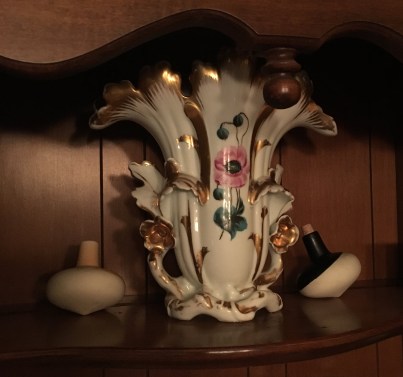
But in the end, my grandmother’s stories always came back to the Houseals. And there were visual aids! Henry Houseal’s Bible from the 1860s, with births and deaths written in his own hand. The Houseal family vase, handed down from mother to daughter or granddaughter for generations. Treasured family recipes for corn pudding and cornmeal mush fried up with maple syrup. These things were like precious treasures to me. Rare connections to the distant past.

But the thing is, even as a kid I knew that not all of my grandmother’s stories could be true. We were Pennsylvania Dutch, she liked to say, come directly from Holland to Maytown in Lancaster County. Reformed and Brethren and Dunkards, farmers all. Even as a nine-year-old I knew what most of you are thinking right now. The Pennsylvania Dutch weren’t from Holland at all. They were from Germany. And that Houseal vase? I could do that math. Houseal was Gladys’s paternal surname. There were plenty of families that vase could be associated with, but if it really was handed down from mother to daughter, the Houseal family wasn’t one of them.

IMG_7895

The “Houseal” Vase – now museum-waxed to my Southern California breakfront

So I grew up surrounded by awesome family stories, but I never knew which ones were true. And I couldn’t ask my grandmother. Because Gladys was always right. About everything. I know, I know, she looks so sweet in that photo up there. Do not be deceived. It was her world and we all just lived in it. Try to tell her that the Pennsylvania Dutch were Germans? Anyone who knew her would laugh at the very idea. I could have pulled out an encyclopedia and shown her, there in black and white, and her only response would have been to lament the fact that Funk & Wagnall’s couldn’t manage to employ decent fact checkers to get these things right. I do not exaggerate. Ask anyone.

If there were holes in our family stories, she was not the person to fill them in.

Was there only ever one family of Houseals? Did we have a patriot ancestor? Were we Dutch or were we Pennsylvania Dutch? (I admit my grandmother’s otherwise inexplicable love of scrapple was a dead giveaway on that one.) These were the burning questions of my youth.

scrapple

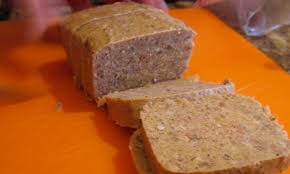
All I’ll say is . . . it’s not a coincidence that the first five letters are SCRAP

Those mysteries jostled around in my brain for decades. Then one day somewhere in the 1990s, I was in an office store, back when office stores had racks of cheap CDROMs offering this or that shareware collection for a couple of bucks each. And as I browsed for interesting games or utilities, I came across something called Family Origins. A genealogy application for your computer. With pretty forms all ready to fill in and guides for starting your research. The questions of my childhood came flooding back to me. I paid my four dollars, took the disc home, stuck it in my 386 (!) and the rest is history.

Family Origins eventually became RootsMagic, the genealogy software I still use. And my grandmother, luckily for me, lived to be 92, more than a decade into my pursuit of genealogy. I was able to share all kinds of amazing discoveries with her. We even figured out who that vase really belonged to. But I never told her about the Pennsylvania Dutch. She went to her grave believing the Houseals came from Holland. Don’t look at me that way. If you’d known her, you wouldn’t have told her either.

babyheart


What’s in a Name?

Because I am over fifty and just figuring out this blogging thing, I signed up for WordPress’s handy-dandy suggestion guide to help my launch my blog with élan. Or something like that. In any case, the second thing it advised me to do (after figuring out how to start this madness) was to blog about the origin of my blog name. And guess what? I was going to do that anyhow! So now of course I’m feeling very smug and like I’ve totally got this blogging thing down. (I just need someone to explain that category vs. tag thing for the fifth time . . .) But I digress.

Here is the story of How I Titled My Blog.

scan0005

This handsome man is my paternal grandfather, Edward Alexander Moore, Jr. And the adorable baby on his lap is me. You can see him up in my banner too. He’s the dashing suited youth smiling above the two doughboys. He’s also the GI on the far right showing off his jeep.

He was Philadelphian to the core. He loved his city so much that it seems a little unfair that he was born – in Altoona, where my great grandparents briefly resided. He did his duty in the war, lost a brother there, came home, took a job at Sears Roebuck and began to climb – all the way up to Vice President of Purchasing for the Eastern Seaboard. Or something like that. It was a long time ago and memory gets fuzzy. What I do remember oh-so-clearly is him and my grandmother taking my sister and I to Chicago in the late 70s to visit the Sears Tower. We got the personal VIP tour – even visited some of the executives in plush offices that thoroughly impressed 11-year-old me. My grandfather was so proud of that building, you’d think he’d laid the cornerstone himself.

SearsTower

Of course I still have my ticket!

He was also as Irish as they come. All four of his grandparents had come from the Emerald Isle. He was one of seven children in a stereotypically boisterous Irish family. Visits to my great grandparents’ house meant loud, laughing uncles, cheek-pinching aunts, and Lawrence Welk on the television. My grandfather’s siblings all looked like each other and they all had that Irish sparkle. That picture up there holding his baby granddaughter? That was him, all the time. I honestly only ever saw him look anything less than joyful twice in my life.

My sister and I called him Baba and we adored him at least as much as he adored us, which was a heck of a lot. He was like one of those movie grandfathers, as far as we were concerned, perfect in every way.

But the title! Right! Well, during one visit when I was maybe six or seven – my sister two years younger – he said to us over breakfast, “Do you girls realize you have the best last name in the world?”

Since we always hung on his every word, we both looked up from our Rice Krispies (or in my case probably Gerber oatmeal because I unapologetically loved the stuff until, like, my preteens) and waited to be told why we had the best last name in the world. I’m sure neither of us questioned the basic premise. If he said it, it must be true.

“Because,” he said, casually, underplaying it perfectly, “whenever anyone likes something, they ask for you.”

Now, we were at most five and seven. We totally didn’t get it. But I think he expected that. I can still hear the exact tone of his voice as he grinned, spread his arms wide, and dropped the punchline. “They ask for MOORE!”

I’m going to be honest; I thought it was pretty corny. After all, I was a wordly-wise second-grader. I knew my way around a silly joke. But today, some 44 years later, that morning joke is one of the tiny percentage of things that happened to me back then that I have never forgotten.

My Baba died when I was twelve, but his impact on my life was profound. And yes, when I decided to bite the blogging bullet, I knew I had to find a way to use his play on words in my blog title. I like what I came up with. I like to think if he were here to see it he’d flash that grin and ask for Moore.

babyheart


You Want to Start a What?

yellow-white-768

A genealogy blog? Why?!

It’s a good question. There are thousands of genealogy blogs out there, maybe even tens of thousands. Does the world need another one? Does it need mine? “What’s the point of it?” was my son’s question. I asked myself an even better one. “Who’s going to read it?” The fact is, I’m only related to about six living people. Okay, that’s a slight exaggeration, but at my wedding my entire family sat at one table for ten and we threw in three family friends and our officiant. So, really, who is going to read it?

But the thing is, I’m a regular listener of Drew Smith and George Morgan’s Genealogy Guys podcast. (And if you’re not, you really should be.) The podcast is a wealth of genealogical information, and Drew and George are very pro-blogging. Everyone, they argue, should be blogging, getting those names out there, sharing those stories, casting bait for cousins. I would listen to an episode, decide to finally start that blog, then spend a week talking myself out of it. Rinse and repeat, for more than a year.

The person who broke that cycle was Sarah Connor. No, not the one from Terminator, although I confess I get a nerdy tingle whenever I see her name in my tree!

Sarah was born in Philadelphia in 1845. She married Edwin Enoch in 1868. She gave birth to at least seven children. And in 1883, shortly after her firstborn son was struck by a train and killed, she was committed to the Norristown State Hospital for the Insane. I don’t know what her diagnosis was. I do know she spent the next 45 years there, until her death in 1928.

ClaraEnoch

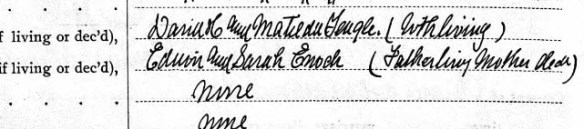
In 1900, husband Edwin was living with a second wife, although so far no divorce or marriage records have been found. When daughter Clara married in 1905 she indicated on her marriage application that her mother was deceased, although she was in fact very much alive and would live another 23 years. When Sarah died the information on her death certificate came from her Norristown files. Despite her having at least three surviving children, no one came forward to act as informant.

As I dug deeper into her life, I couldn’t get Sarah out of my mind. Did anyone ever visit her? Did her children even know she was still alive?

Sarah’s not the only woman in my family tree to have been “put away” in an asylum in the 19th Century. I’m pretty sure we all have them in our families. At the time, institutionalization was a disturbingly common way to dispose of women who didn’t conform to the narrow definitions of acceptable behavior. And the women targeted had almost no rights or recourse. They were at the mercy of a system they weren’t allowed to participate in. One that only valued them in very specific contexts.

Sarah reminded me that none of our ancestors lived in a vacuum. They defined and were defined by the times they lived in. Their stories are personal but they’re also universal. And they deserve to be shared and read, and maybe even inspire others to tell the stories of their ancestors.

I love history; I think we all do. Part of the reason we’re drawn to genealogy is the way it helps us personalize the past. So I’m going to stop worrying about who might read this blog and just dive in. I’ll share things, learn things, hopefully become a better writer. And maybe I’ll even catch some cousins!

babyheart